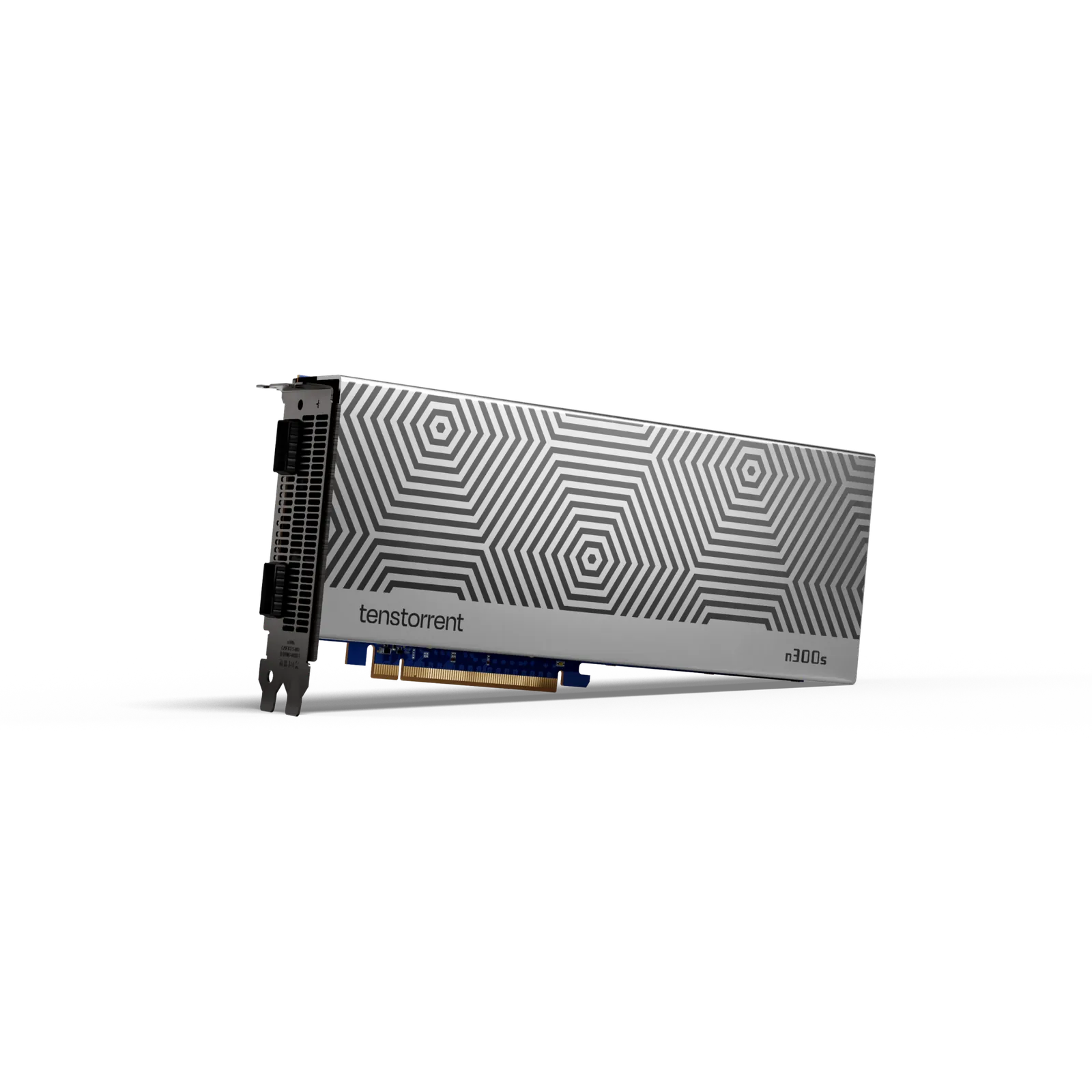
- Tenstorrent Wormhole24 GB · runs 30–34B models at 4-bit
Full specifications
- Processors
- 2 × Tenstorrent Wormhole
- Tensix cores
- 128
- Memory
- 24 GB GDDR6 (12 GB per chip), 576 GB/s total
- On-chip SRAM
- 192 MB
- Host interface
- PCIe 4.0 x16
- Card-to-card
- 2 × QSFP-DD 200G, 2 × Warp 100 bridge
- Board power
- 300 W
- Power connector
- 1 × 4+4-pin EPS12V
- Cooling
- Passive heatsink: needs strong server airflow
- Form factor
- Dual slot, 254 mm long
- Software
- Open source: TT-Metalium, TT-Forge
Good for
- Developers starting on Tenstorrent's open-source stack
- Learning multi-chip programming on one card
- Building small multi-card systems with Warp 100 bridges
Not ideal for
- CUDA-dependent tools or broad day-one model support
- Models above 30B at 4-bit on one card
- Gaming or display output
- Desktop towers without strong airflow, unless you add the Active Cooling Kit
Tenstorrent
Tenstorrent Wormhole n300s
Two Wormhole processors on one passively cooled PCIe card, with 128 Tensix cores and 24 GB of GDDR6 between them. It runs on the same open-source software as the newer Blackhole cards, and several cards can be chained together.
£1,169Charged in euros at checkout: €1,399. Import duties and taxes included.In stock. Dispatched in 1 to 3 business days.
- 30-day returns
- Free shipping over €199, charged in euros
- Ships from our UK warehouse
- Import duties and taxes included
- Shipping, returns and warranty
What it can run
Up to 30–34B at 4-bit, 13–14B at 8-bit (approximate)
Based on 24 GB of GPU memory. See every machine by model size
Guides for this product
Local AI · 5 min read
How Much Memory Do You Need to Run a Local LLM?
How much memory a local LLM needs: 7B to 120B+ models at 4-bit and 8-bit, how unified memory differs from VRAM, and which machines hold each size.
Read the guide →Local AI · 5 min read
Mac vs NVIDIA vs Ryzen AI Max+ for Local AI
Which platform fits which work: CUDA on NVIDIA, unified memory on a Mac, or 128 GB on a Ryzen AI Max+ mini PC. Memory, software and trade-offs.
Read the guide →About the Tenstorrent Wormhole n300s
The Tenstorrent Wormhole n300s puts two Wormhole processors on one passively cooled PCIe 4.0 card, with 128 Tensix cores and 24 GB of GDDR6 split 12 GB per chip. It runs the same open-source software as the newer Blackhole cards at a lower entry point. Buy it to learn and build on Tenstorrent's stack, or to chain several cards together, if you are comfortable working outside CUDA and have a server with strong airflow.
Key features
- Two Wormhole processors: 128 Tensix cores (64 per chip)
- 24 GB GDDR6 (12 GB per chip), 576 GB/s in total
- 192 MB on-chip SRAM (96 MB per chip)
- 466 TFLOPS FP8, 131 TFLOPS FP16
- 2 × QSFP-DD 200G ports plus Warp 100 bridge connectors
- PCIe 4.0 x16, 300 W board power, passive heatsink
What it runs
The memory is split between two chips, which shapes what fits. With about 90% counted as usable, each chip holds roughly 10.8 GB: enough for a 7–8B model at 4-bit or 8-bit, or a 13–14B model at 4-bit, on a single chip. A 30B-class model at 4-bit fits only when it is split across both chips, so check that the model you want has a working multi-chip version in Tenstorrent's model library.
| Model size | 4-bit | 8-bit |
|---|---|---|
| 7–8B | Fits on one chip | Fits on one chip |
| 13–14B | Fits on one chip | Both chips |
| 30–34B | Both chips | Does not fit |
| 70B | Does not fit | Does not fit |
Two chips on one board
The two Wormhole processors on the n300 are linked on the board at 200G. Software sees them as two devices that can work together, which is why multi-chip support in the model matters more here than on a single-chip card. The upside is that the same skills carry over to larger Wormhole and Blackhole systems.
Linking cards
Each card has two Warp 100 notches for internal bridges to a neighbouring Wormhole card, and two active QSFP-DD ports at 200G for connecting cards or Wormhole systems. Both connect only to Wormhole hardware.
Cooling, host and power
- n300s (part TC-02003): passive heatsink, dual slot, 254 mm long, for servers with forced front-to-back airflow
- Without that airflow, as in most desktop towers, Tenstorrent requires its Active Cooling Kit
- One 4+4-pin EPS12V power connector (not a PCIe 6+2-pin cable)
- x86_64 host with a PCIe 4.0 x16 slot, 64 GB of system memory and Ubuntu 22.04
If the card is not cooled well enough, it slows itself down to stay within safe temperatures. Plan the airflow before you buy: this is the passive server version.
Software
The n300 runs the open-source TT-Metalium, TT-NN and TT-Forge stack, shared with Blackhole. It is not a CUDA card. Supported formats include FP8, FP16, BFLOAT16, block floating point and INT8.
What to pair it with
A server or workstation with a free PCIe x16 slot, strong airflow across a 300 W passive card and an EPS12V cable from the power supply. When you outgrow it, the Blackhole p150a offers 32 GB on one chip and faster links. To see how this card compares with GPU options, read graphics cards for local AI.
Good for
- Developers starting on Tenstorrent's open-source stack
- Learning multi-chip programming on one card
- Building small multi-card systems with Warp 100 bridges
Not ideal for
- CUDA-dependent tools or broad day-one model support
- Models above 30B at 4-bit on one card
- Gaming or display output
- Desktop towers without strong airflow, unless you add the Active Cooling Kit
The 24 GB is split across two chips (12 GB each), so larger models have to be spread across both. Check that the model you want has a working multi-chip version.
Who it's for
Developers who want to learn and build on Tenstorrent's open stack at a lower entry point than Blackhole.
Full specifications
- Processors
- 2 × Tenstorrent Wormhole
- Tensix cores
- 128
- Memory
- 24 GB GDDR6 (12 GB per chip), 576 GB/s total
- On-chip SRAM
- 192 MB
- Host interface
- PCIe 4.0 x16
- Card-to-card
- 2 × QSFP-DD 200G, 2 × Warp 100 bridge
- Board power
- 300 W
- Power connector
- 1 × 4+4-pin EPS12V
- Cooling
- Passive heatsink: needs strong server airflow
- Form factor
- Dual slot, 254 mm long
- Software
- Open source: TT-Metalium, TT-Forge
Reviews
Atomrig customer reviews
No customer reviews yet. Bought this from us? Tell us how it runs.
Related products
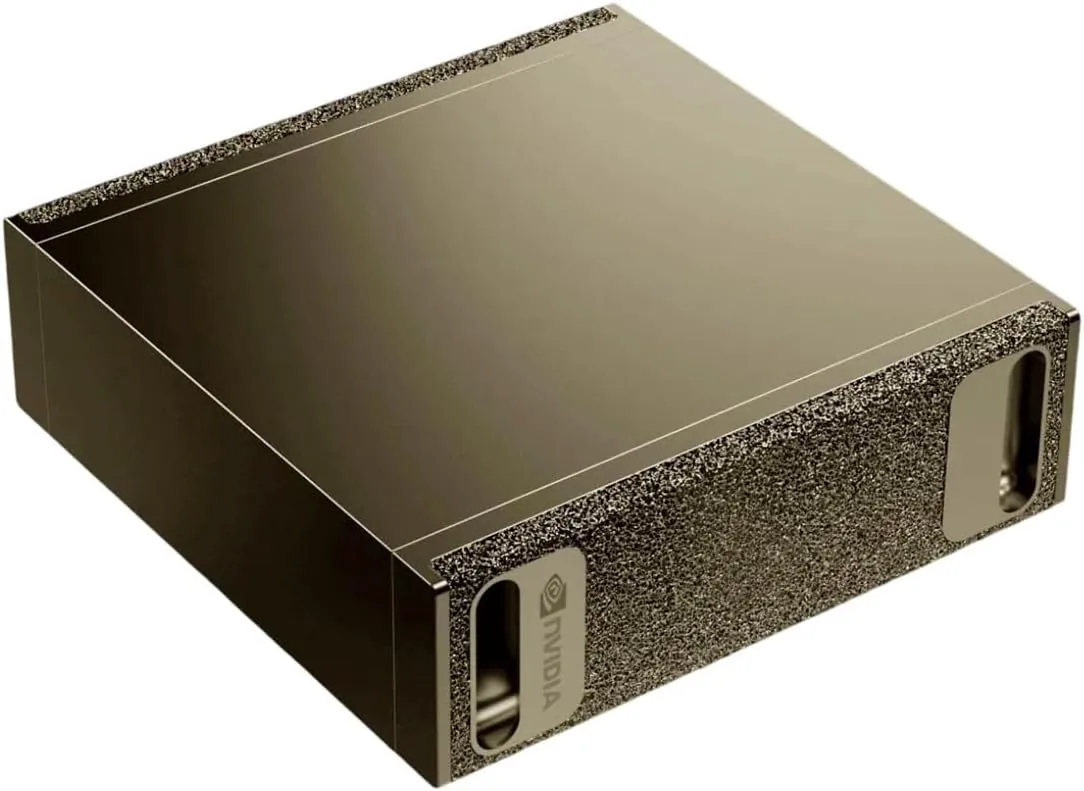
NVIDIA
NVIDIA DGX Spark
Runs up to 120B+ at 4-bit
- 128 GB unified
- NVIDIA GB10 Grace Blackwell
Its memory bandwidth (273 GB/s) is lower than a high-end graphics card's, so large dense models generate text more slowly than they would on an RTX 5090. Its strengths are capacity and the CUDA software stack.
£3,929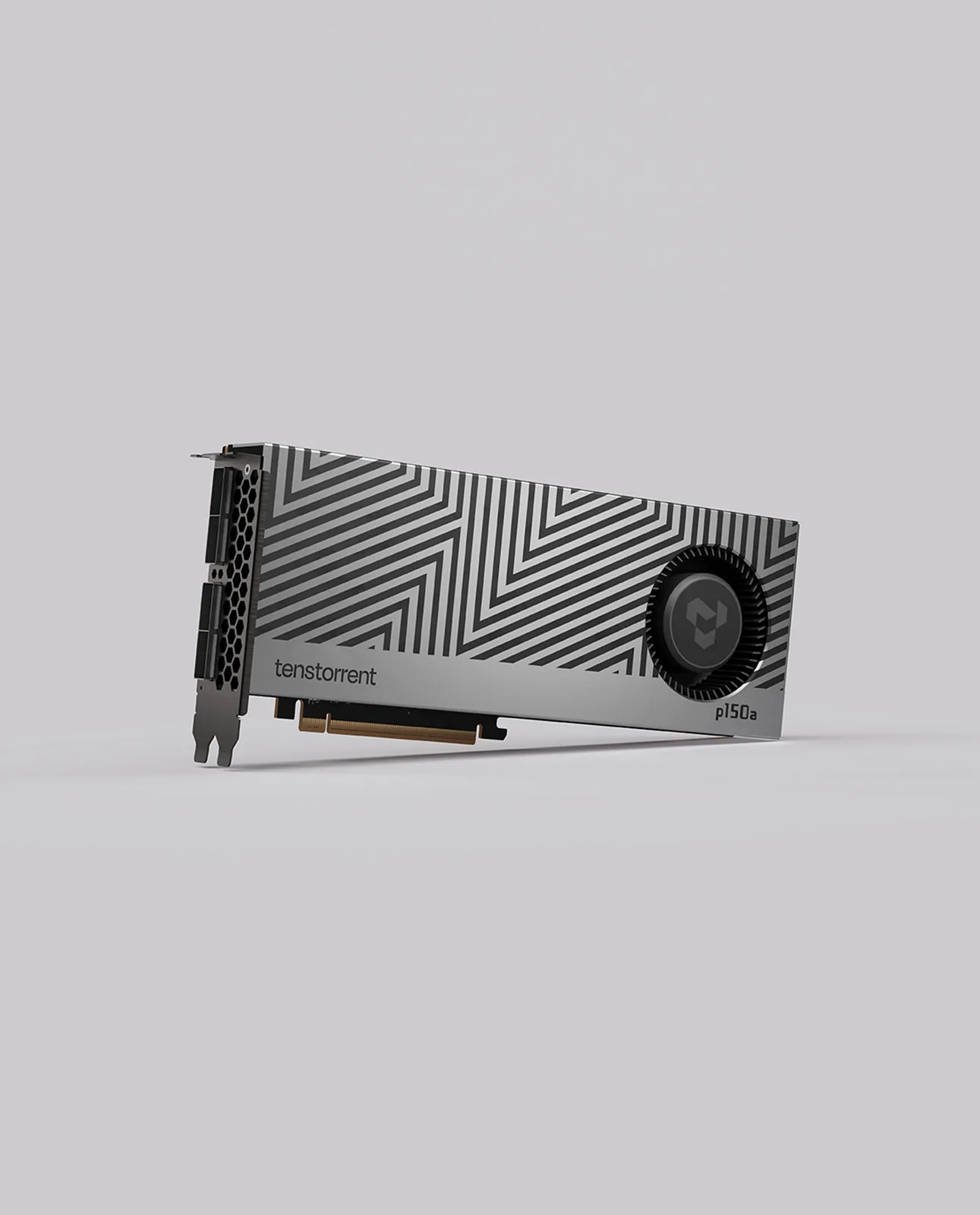
Tenstorrent
Tenstorrent Blackhole p150a
Runs up to 30–34B at 4-bit
- 32 GB
- Tenstorrent Blackhole
This is not a CUDA card. Check that the models you need are supported in Tenstorrent's open-source model library before you buy.
£1,169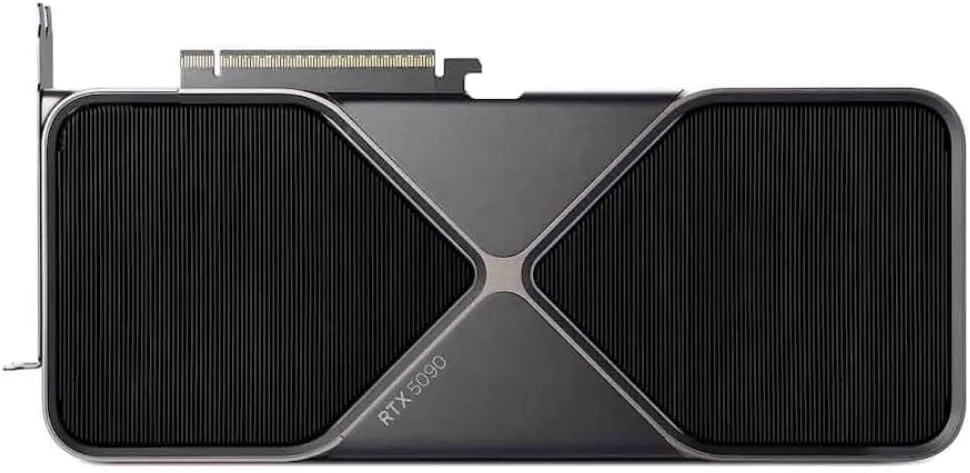
NVIDIA
NVIDIA GeForce RTX 5090
Runs up to 30–34B at 4-bit
- 32 GB
- NVIDIA Blackwell (GB202)
32 GB runs 30B-class models comfortably at 4-bit, but a 70B model will not fit on one card. For 70B, plan for two cards or a large unified-memory system.
£1,669
PowerColor
PowerColor AMD Radeon AI PRO R9700 32GB
Runs up to 30–34B at 4-bit
- 32 GB
- AMD RDNA 4 (Navi 48)
Check that your tools support ROCm on your operating system before buying. PyTorch and llama.cpp do; some niche tools still assume CUDA.
£1,089